Why Interior Design Is the Next Vertical AI Will Transform
We sat in the studios. That changed everything.
Before we wrote a single line of code for OpenMaison, we spent four months inside real interior design studios in Singapore and Dubai. Shadowing owners. Watching designers juggle WhatsApp threads. Sitting through client meetings where half the time went to pulling up the right file, the right version, the right quote number.
The design work was brilliant. What struck us was everything around it. A studio owner in Jurong told us she spends her Sundays copying lead details from Google Sheets into her invoicing app. A firm in Business Bay had three designers on the same project who'd each quoted slightly different numbers to the same client, because nobody could find the latest revision.
These are talented people doing repetitive admin because their tools don't talk to each other. And that gap, between the creative work designers want to do and the operational work they're stuck doing, is exactly where AI is about to land.
The numbers are moving fast
The AI-in-interior-design market is valued at $1.76 billion in 2026 and projected to hit $4.55 billion by 2030, a compound annual growth rate of 26.8% (Research and Markets). That's not a slow burn. That's vertical SaaS growth territory.
And the adoption numbers already tell us something interesting. According to Mattoboard's 2025 industry survey, 82% of professional designers now use AI tools on a regular basis. That's higher than most people expect. But look at what they're actually using it for, and the picture gets more specific: most of that usage is visualisation. Generating room renders, playing with colour palettes, trying mid-century modern vs. Japandi aesthetics on the same floorplan.
Visualisation is genuinely useful. We're not dismissing it. But it's the tip of a much larger iceberg. The real time sinks in a design studio are not creative. They're operational. Lead follow-ups that slip. Quotes that take three days to prepare. Invoices that go out with the wrong tax calculation. Projects that drift over budget because nobody reconciled the purchase orders against the original scope.
That operational layer is where AI can do the most damage, in a good way.
What vertical AI did to law, real estate, and construction
Interior design isn't the first profession-specific industry to get this treatment. Looking at what happened in adjacent verticals is instructive.
Clio transformed legal practice management. Before Clio, law firms ran on paper files, manual time tracking, and desktop software that hadn't been updated since the early 2000s. Clio gave them cloud-based case management, client intake, billing, and (more recently) AI-powered document drafting. The company hit $100 million in annual recurring revenue and serves over 150,000 legal professionals globally (Clio 2024 Annual Report). Clio won because it understood the specific workflow of a law firm and built around it.
AppFolio did something similar for property management. Procore did it for construction. In each case, the winning product was always the one that mapped most closely to how the professionals actually worked day to day.
Interior design is structurally similar to these verticals. It's a fragmented market of small to mid-size firms. It's operationally complex, with long project cycles and lots of stakeholders (clients, contractors, suppliers, authorities). And it's been underserved by generic software that doesn't understand the domain.
That combination of fragmentation, complexity, and underserved tooling is exactly what vertical AI thrives on.
Where the real AI opportunities sit in a design studio
Let's get specific. Here are the operational bottlenecks where AI has a genuine, measurable impact today. Not in two years. Now.
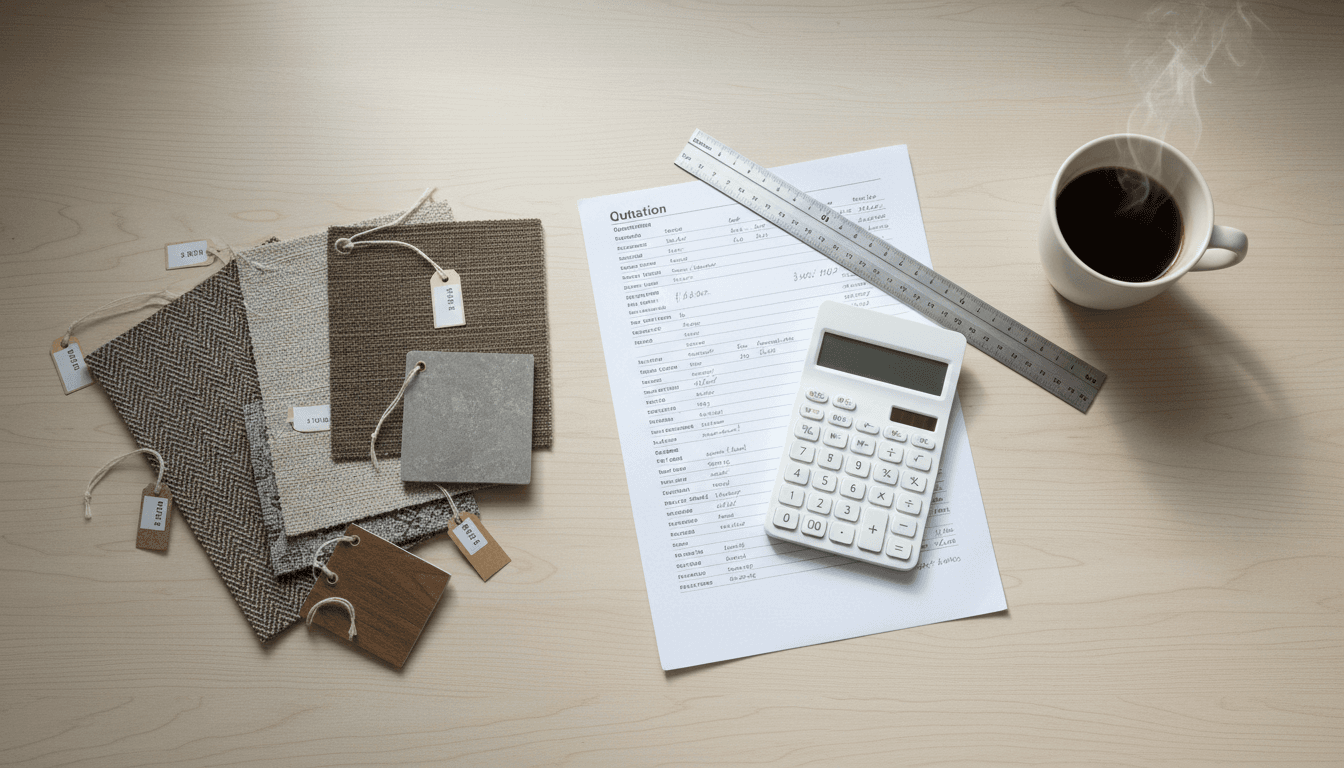
Quote digitisation. A contractor sends a 14-page PDF quotation. Somebody has to read it, line by line, extract items, categorise them, check for missing scope, and enter everything into a spreadsheet. AI can do this in seconds. Upload the PDF, get a structured table with categories, unit prices, quantities, and flagged anomalies. We've seen this cut quote processing from 2-3 hours to 10 minutes.
Then there's lead prioritisation. A studio with 5 designers might get 30-50 enquiries a month. Some are tyre-kickers, some are ready to sign next week. Instead of treating them all equally (or, more likely, responding first to whoever messaged last on WhatsApp), AI can score leads based on budget fit, project type, response speed, and historical conversion patterns. The designer's time goes to the leads that matter most.
What about during the meeting itself? An AI co-pilot during client consultations can listen to the conversation and surface coaching prompts, deal signals, and rough cost estimates in real-time. The client doesn't see any of it. The designer just seems better prepared. This is newer and frankly still being proven out. We're building it at OpenMaison (full disclosure: we're biased), and early results are promising, but we're honest that it's still early.
Compliance automation is another area with immediate payoff. In Singapore, an HDB renovation requires permits for specific works (hacking walls, moving plumbing, installing a shower screen in certain configurations). In Dubai, DDA and Trakhees approvals have their own requirements. Feed a renovation plan to an AI, and it can generate a checklist of what needs approval before work begins. This saves junior designers from making expensive mistakes.
And then there's the quiet margin killer: the gap between what was quoted and what actually gets invoiced. AI that watches purchase orders, variation orders, and expense claims against the original budget can flag margin erosion before it becomes a problem.
Why visualisation alone won't cut it
There's a reason most AI adoption in design has clustered around visualisation. It's the easiest to demonstrate. You show a client a photorealistic render of their living room and they go "wow." That's a powerful sales tool.
But visualisation leaves the studio's operations untouched. A beautiful render won't get that follow-up email sent on time. The designer still undercharges because demolition costs got left off the quote. The project still crosses from profitable to break-even because of an untracked change order.
The studios we've seen grow fastest aren't the ones with the best renders. They're the ones with the tightest operations. The ones where every lead gets a response within 2 hours. Where every project has a clear financial picture at any given moment. Where the owner can pull up a dashboard and see which designer is over-committed and which has capacity.
Operational AI is less photogenic than render AI. Nobody posts a screenshot of their automated lead scoring pipeline on Instagram. But it's the work that actually scales a studio from 3 people to 15.
What's holding adoption back
If AI is so useful, why isn't every studio already using it for operations? A few honest reasons.
Trust. Designers are creative professionals. They didn't get into this field to have software tell them what to do. There's a legitimate concern about AI making decisions (assigning leads, prioritising tasks, flagging quotes) that should involve human judgment. The best AI tools treat this as augmentation, not replacement. Surface the information, let the human decide.
There's also a data problem. Operational AI needs data to work with. If your studio's lead history lives in someone's WhatsApp and your financial records are in a folder of Excel files on a desktop, the AI has nothing to learn from. This is why all-in-one platforms have an advantage: once you're running your studio through one system, the data is already structured.
Cost sensitivity plays a role too. Most design studios are small businesses. A 5-person firm in Singapore might generate $800K-$1.5M in annual revenue. Spending $500/month on software is a real decision, not a rounding error. AI tools need to demonstrate clear ROI, ideally in hours saved per week, not in vague "productivity gains."
And then there's the noise. Dozens of companies claim to offer "AI for designers." Most of them are a thin wrapper around GPT-4 with some interior design prompts. Separating genuine tools from marketing fluff takes time that busy studio owners don't have.
Where this goes from here
We think interior design follows the same arc as legal tech and proptech, just a few years behind. The progression looks roughly like this:
Phase one (roughly 2023-2025): AI for visualisation. Render generation, mood boards, style exploration. This phase is largely done. Most studios have tried these tools.
Phase two (2025-2027): AI for individual tasks. Quote digitisation, lead scoring, compliance checks. Standalone features that solve one specific pain point. We're in this phase now.
Phase three (2027-2029): AI as an integrated operating layer. The system understands the full lifecycle of a project, from the first enquiry to the final invoice. The system anticipates problems before they surface. It recommends actions, not just reports. This is where we're building towards, and where we think the most value gets created.
We don't know exactly how fast this will move. Clio took roughly 8 years to go from "legal practice management software" to "AI-powered legal OS." The tools available today suggest interior design could compress that timeline. But adoption curves are unpredictable, and small business owners are rightly cautious about changing the tools they rely on every day.
What we do know is that the studios spending 12-15 hours a week on admin work have a problem that technology can solve. Whether they solve it with AI-powered platforms or with better spreadsheet discipline, that time is getting reclaimed. We'd bet on the AI route, but then again, we would say that.